Sunday March 2 - Thursday March 6,
Jerusalem, Israel
A national carrier's check-in desk is frequently a microcosm of that nation, and the check-in desk for Israel's El Al Airlines at Heathrow is no exception: "Why are you going to Israel?", "For how long?", "Why have you recently been in Tunisia?" The questions continue, and then the X-rays and searches begin. My hand luggage is taken from me and only returned at the departure gate, and my bags are minutely examined. Fortunately, my father's instruction to "wear my smartest underwear" proves an unnecessary precaution.
It's all mildly irritating. and my schoolboy-before-the-headmaster over-
politesse feels a compromise -- but it's a useful reminder of what I'll face in a few hours, and it's a small price to pay for visiting a country which has long been on my wish-list. The five-hour flight passes quickly and I'm met at
Ben Gurion airport in Tel Aviv and driven to East Jerusalem. The journey takes just under an hour and our fixer, Sharon Schaveet meets me at the hotel.
Employing fixers is a somewhat risky business, and most production web-sites are flooded with the familiar request: "does anyone know of a good fixer in…(name of country here)". Find a poor fixer and the shoot can rapidly deteriorate into farce. Find a great fixer, and you'll start thinking that it's the best money one can spend on a production. Thankfully, Sharon is of the latter school. A wonderfully efficient tour-de-force, she allows nothing to defeat her -- police, soldiers, bureaucrats, crew-members, myself -- we're all cajolled, encouraged, charmed and threatened into line.

In an essential briefing Sharon warns me that the situation is particularly tense at the moment. Israel has launched a major offensive in Gaza and violence has spilled over into Jerusalem. Both Palestinians and Jews are extremely wary. It's going to be a fascinating few days.
My mission to Israel is two-fold. For the Islam film, I'm shooting perhaps the second most significant site (if we regard Mecca and Medina as one) in the Islamic world, the
Dome of the Rock. And for the Judaism film, I'm spending a day at
Masada, capturing one of the few remaining ruins of Second Temple Synagogues. In total I have three days.
Day One and we're blessed with sensational weather: an azure sky, a few clouds and no heat-haze at all. Perfect conditions. I'm picked up at seven in the morning and Sharon introduces me to the rest of the crew: driver Arie, director of photography Ofer and camera assistant Gabi. Later I'll meet the sound-man Nicholas. They're warm, relaxed and enthusiastic about the coming shoot.

The Dome of the Rock is situated on one of the most contested sites in religious history -- a vast ancient platform known to Jews as the
Temple Mount and to Muslims as the Haram al-Sharif or
Noble Sanctuary. In Islamic history, the Rock is the location for the Prophet Mohammed's encounter with the angel Gabriel and his ascension to Paradise, while for Jews, the Temple Mount is the foundation for their holiest of sites, the Davidic Temple.
Although governed by a ruling Islamic body, the Noble Sanctuary is nevertheless carefully monitored by Jewish police. The dynamic between the two nationalities at the gate is fascinating -- my absence of Hebrew or Arabic impedes any thorough insight but the uneasy truce is evident; there is much gesticulating and gesturing, some shouting, appeals for calm, much pointing at the crew and our equipment, occasional laughter and of course lots of guns.
Amid the stand-off is Sharon -- occasionally vociferous, mostly pleading. She's warned us beforehand that anything can happen at the entrance to the Dome of the Rock -- there are no guarantees that we'll be allowed to film, nor for how long. But she keeps on pushing. "She'll call the prime minister next," quips Ofer, awed by her persuasive prowess. She's been negotiating our access with both sets of officials for weeks.

And then suddenly, we're admitted. The crew is asked not to speak Hebrew and we're led inside the Dome of the Rock and into one of the most sacred sites in Islam, to the cave itself where it's believed Mohammed met with Gabriel. The Waqf or ruling Islamic officials have offered us an incredible privilege - filming permission here is very rare, and almost never with a large broadcast camera (we're shooting on HD), let alone a tripod.
We do not have a great deal of time but what we do film is remarkable. After twenty minutes we're hurried upstairs and once again given permission to film the interior of the Dome.We film what we can -- but one could spend days here. The tiling and mosaic glass is exquisite and the designs so varied and complex, mostly patterning but discernible are trees, flowers, vegetation and fruits. In the middle of the dome is the stone roof of the cave but extensive scaffolding hampers our view. There's not enough time -- the call for prayer is approaching and the next minute Sharon tells us that we have to leave the site. I protest, entreating her that we need time to shoot exteriors, but the decision is out of her hands. As quickly as we've arrived, we find ourselves outside the entrance gate.
It has not worked out quite as we'd hoped, although the interior access was remarkable. But without filming the exteriors, we don't have a film. Sharon is concerned too, and we decide to talk everything though over a coffee -- we walk down the
Via Dolorosa. It's my first sight of street-level Jerusalem and I can't help staring: there are Armenian priests, Orthodox Jews, nuns, hawkers, bodyguards, soldiers and of course coachloads of tourists -- the mix of people is astonishing.

Once we've relaxed a little, Sharon says she'll work hard to convince both the Israeli policemen and the ruling Waqf to allow us access for the following day. She refuses to be drawn on whether it's likely but she'll do everything she can. In the meantime, we can spend some time sourcing a suitable roof-top to film the interview with our Islamic expert. We explore various options and eventually decide on the roof of the Austrian Hospice. It affords us a wonderful view of the Dome and we set for the interview.
Dr Marwan Khalaf is an expert in Islamic art and architecture and proves a gentle and knowledgeable interviewee. Among much else, he explains about the evangelistic role of the Dome of the Rock -- it was partly constructed to compete with (and surpass) other religious structures in Jerusalem, and he tells us too about the mathematical symmetry of the Dome -- 4 doors, 8 sides, 16 columns, 52 windows etc. It's a very constructive couple of hours and we end the day with some sunset shots from the Mount of Olives before a 6 o'clock lunch.
Day Two and Sharon has decided that the best thing to do is just to pitch up early at the Dome and try our luck. We squeeze in a sunrise shot first thing and then head to the entrance. Ofer and I exchange ideas about the routine which dominates much of filming -- "Hurry Up and Wait" -- and we shoot some general footage while waiting to hear news of progress. Sharon calls. If we come this minute, she thinks we can get in. She's right and once again we get access. Other crews don't fare so well -- there's a media ban in place and among others, the BBC are turned away.

One of the privileges of filming is the opportunity to look at buildings in significant detail, courtesy of a long lens. And the Dome doesn't disappoint -- the golden cupola steals the headlines but the windows, walls, even guttering are just as remarkable. Again it's a day of blue skies, and the structure looks wonderful. We could spend all day here, and another day too, but we've pushed our luck already and the governing Waqf have indulged our schedule to an incredible degree. We say our thank you's and leave the Dome of the Rock.
Except of course we don't. Just by the entrance of the Noble Sanctuary, two abandoned rucksacks have been identified as suspicious. We and our equipment are held at the gate as an explosives robot rumbles into action. We're ushered out of the sight-line and hear six muffled shots -- the sound of the robot shooting the packages. Predictably the rucksacks prove to be only that, but the situation doesn't help tension levels.
A coffee later, and we're filming street scenes, market scenes and Jerusalem establishing shots. Our final location for the day is the
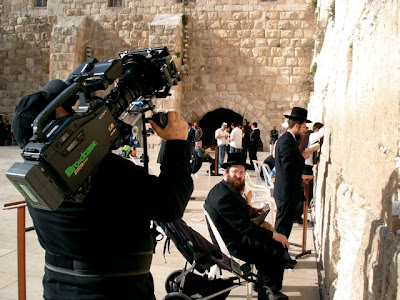
Western Wall -- often referred to as the wailing wall. It's one of those scenes with which one has become so familiar, but up close, the whole experience is of course far more vivid. We film right by the wall and I feel a touch uncomfortable at our proximity to the worshippers. Not so Ofer and, seemingly, not so the Orthodox Jews who continue, indifferent to our presence. The early evening is spent having dinner at Restobar. "Oh this place," remarks the camera assistant, Gabi, "you may remember, it was decimated by a suicide-bomber a couple of years ago."

Day Three and leaving Jerusalem behind us, we're driving alongside the Dead Sea on our way to Masada. Ever since seeing Peter O Toole in the
1981 mini-series of the siege, I've wanted to come here, probably along with many thousands of others.

The story of Masada is an extraordinary one. In 66 CE a group of rebels from a Judaic extreme sect, the Sicarii, surprised and overcame the Roman garrison at Masada. With cliffs rising 400 metres above the desert, the site offered a near impregnable natural fortress (complete with huge food stocks and its own well). In turn, the Romans besieged Masada, constructing a vast rampart which enabled the defenses to be breached. When the Romans entered the fortress in 72 CE, they discovered that all 936 inhabitants had committed suicide rather than face captivity. Dramatically symbolic, Masada is now Israel's second most popular tourist site.

Our focus for the day is Masada's synagogue. Not much remains - a few broken walls, pillars and the steps bordering the walls where worshippers would sit, pray and listen to readings of the Torah. A converted stable, the building is incredibly simple and pure; a rejection of the rich colour-schemes and ornate construction of the surrounding Roman buildings. Nevertheless, I find it beautiful -- concise, straightforward and modest.
Archaeological expert Avner Goren is our guide. He's a fabulous contributor -- experienced in the trials of television, he's both patient and charismatic, content to wait in the sun while we tinker with our set-ups. He draws a vivid account of the siege and is alive to contemporary parallels with Gaza. He also highlights the fact that for many Israelis, Masada is a symbol with which they no longer wish to be closely allied -- they don't want to be isolated from other communities or nationalities; instead they want actively to engage with them.

We film until 4pm and then catch the final cable car down the slopes. A few last sunset shots over the desert and we drive back to Jerusalem. One last supper and a flight home. At the hotel, I'm asked whether, for the journey to the airport, I'd prefer a Jewish taxi-driver or a Palestinian taxi-driver. Only in Israel. (Seb Grant)
 When Ian & I first reached Princes Road Synagogue in the car, we went straight past it. It was only on the second drive along Princes Road that we realised we must have found our (unnamed) building. With rows of lofty Victorian terrace houses and deserted husks of houses of worship of various dominations, Princes Road in Toxteth, Liverpool, wistfully communicates a sense of a more prosperous era long since past. Nestled amongst all these houses and battered old churches, Princes Road Synagogue is initially somewhat unremarkable. The façade has character and contains notable elements reminiscent of the Dohany Street Synagogue or Central Synagogue New York, but on this run down street it seems somewhat muted.
 Enter the synagogue, however, and a completely different visual experience is revealed. Princes Road Synagogue is like a small, beautifully vibrant and stylistically busy Dohany Street Synagogue. With one gallery and no central row of candelabras, the synagogue contains unique choir stalls perched above a stunning Byzantine-style Ark with a deep blue cupola, beautiful rose windows and an extraordinary variety of patterns on the walls and ceilings.
 On Sunday we had little time to appreciate such detail however as we tip-toed around the galleries in order to film shots of a civic ceremony that was taking place below us that afternoon. The synagogue was packed with their congregation and various dignitaries of Liverpool, including the Lord Mayor and his entourage. We snuck around filming shots of a busy congregation and readings accompanied by melodious singing from the uniquely mixed choir, as conducted by our interviewee, Naomi Hoyland. In the last section of the ceremony Ian and I managed to creep up the small spiral staircase leading up to the choir stalls and grab some shots of Naomi conducting as the choir sungs their hearts out. Before we knew it the service was over and Eddie the caretaker was keen to lock up for the night.
 Early the next morning we set about filming with Naomi, as she told us the story of how the synagogue came to be, who frequented it, its situation today and her own connections with the building. The synagogue had originally been created in the nineteenth-century for the wealthy Jews in Liverpool who wanted a grand synagogue to match their status -- the existing one in town was not opulent enough and anyway they wanted one nearer their smart homes. A competition was held and two Scottish architects, the Audsley brothers, won the commission. They had also built the Welsh Presbyterian Church on the other side of the street – which now very sadly sits as a Gothic shell, falling down and bordered up. The congregation all put in what money they could afford to fund the new building – as two plaques in the lobby attest. The Audsley brothers apparently travelled the world picking out beautiful and eclectic designs which they blended together for the interior of the synagogue. The congregation had never seen anything liked it and loved it!
 One of the most interesting moments during my interview was learning that the number of Jews in Liverpool is declining. All the children move out to Manchester and elsewhere. The ever-dwindling number of Jews makes it very difficult to maintain the synagogue (which is now a Grade I listed building) and sustain the congregation. It's for this reason that Naomi took on the task of synagogue tour guide, so that she can introduce to new people this wonderful building. She also showed me two beautiful lectern-chairs on the pulpit that her father had crafted for the synagogue several years ago, when he was 91. Seeing those two chairs and hearing about his life’s work for the synagogue, it gives me faith that Naomi Hoyland and passionate congregants like her are not going to let Princes Road Synagogue fall into the decline that has afflicted the other religious buildings on Princes Road. (Nonie Creagh-Brown)


